agentgateway v1.4.0 landed on July 27, 2026.
If you are still on 1.3.x, this is the upgrade map. It tracks the official v1.4.0 release notes — highlights, breaking changes, security, and the day-2 bits that actually matter — plus a bit of operator commentary.
Also useful
- v1.3.0 · v1.3.1
- Diff: v1.3.1…v1.4.0
Install bits
- Images:
cr.agentgateway.dev/agentgateway:v1.4.0,cr.agentgateway.dev/controller:v1.4.0(glibc — no more musl image tags) - Charts:
agentgateway,agentgateway-crds,agentgateway-standalone - Binaries: still built with musl; proxy +
agctl
The short version
Upstream’s own highlight reel:
- Full MCP
2026-07-28support (and a year of community work behind it) - Cross App Access / Enterprise-Managed Authorization for MCP (ID-JAG)
- OAuth token exchange backend auth (RFC 8693 + JWT bearer)
- Standalone
gateways+ DB-backed UI config (sqlite / postgres) + standalone Helm chart - Experimental
AgentgatewayModelon Kubernetes (off by default) - Gateway API v1.6, fault injection, richer guardrails, lots of fixes
My add-on for operators: read the breaking + security sections before you helm upgrade. There is a High severity MCP auth advisory in this release.
| Area | What moved |
|---|---|
| MCP | Protocol 2026-07-28, Apps, traces via _meta, Entra/Descope/authentik |
| Auth | Token exchange, Cross App Access (incl. MCP EMA), hashed API keys |
| Standalone | gateways supersede binds, UI on same port, sqlite/postgres storage |
| UI | Settings to bind console + attach OIDC/JWT/API key/CSRF/CORS |
| Kubernetes | Experimental AgentgatewayModel (off by default) |
| Platform | DaemonSet, Gateway API 1.6 / TCPRoute v1, monitors, delay fault injection |
| Security | GHSA-mvgg-jvj2-4frq + CEL body guidance |
Read this first: breaking changes
Straight from upstream. Do these before you call the upgrade done.
1. Gateway API v1.6 and TCPRoute v1
agentgateway builds against Gateway API v1.6. The controller uses TCPRoute v1, not v1alpha2.
Action: re-apply the Gateway API CRDs that match this release before you upgrade the controller/proxy.
2. MCP request-phase guardrail rejections return HTTP 200
If an MCP guardrail rejects in the request phase, the gateway now returns HTTP 200 with a JSON-RPC error body — same as the response phase.
Action: fix clients/tests that expected a non-200 on request-phase rejects.
Docs: k8s MCP guardrails · standalone
3. Standalone auth.location no longer nests expression
Custom token location config dropped the double-nested expression field. Use the flattened form.
Action: grep your standalone policies for nested auth.location expressions and update them.
4. musl container images removed
Musl image variants are gone. Use standard glibc images. Binary releases are still musl builds.
Action: update image pins, digests, and SBOMs.
Read this second: security
High: MCP sessions crossing routes (GHSA-mvgg-jvj2-4frq)
This release fixes GHSA-mvgg-jvj2-4frq — High (8.1) — where stateful MCP sessions could cross routes and overwrite authorization policy.
Read the advisory for impact and mitigation. Credit: Aonan Guan.
Related hardening in the same train includes pinning MCP sessions to a backend and tightening passthrough checks. Still: if you run MCP with authz on 1.3, treat 1.4 as a security upgrade, not just a feature bump.
CEL request.body / response.body in auth policies
Upstream flags a footgun (recommendation + behavior change), also from the same reporter.
| Attribute | 1.3.x and earlier | 1.4 |
|---|---|---|
request.body | Truncated to http.maxBufferSize (default 2MB) | Not available if truncated |
request.truncatedBody | Not available | Truncated to max buffer size |
Why it matters: a policy like string(request.truncatedBody).contains("attacker-payload") can miss a match when the body is over 2MB, or when encoding/compression changes what you thought you were matching. Auth on raw bodies is easy to get wrong.
Action: audit CEL auth that touches bodies. Prefer not using body contents for hard authorization when you can avoid it. If you must, handle the “body missing / truncated” case explicitly.
What 1.3 already gave you
v1.3.0 brought the rebuilt UI (LLM / MCP / Traffic), cost tracking, virtual models, reusable providers/guardrails, more LLM providers, body buffering, better CEL/agctl, better traces.
v1.3.1 was polish: controller podLabels, Vertex multi-region, same port with different protocols across gateways, UI wildcard/virtual-model fixes.
1.3.1 does not force a redesign. 1.4 does — config shape, CRDs, MCP auth behavior, and at least one security-fixing upgrade path.
1. MCP protocol 2026-07-28
This is highlight #1 in the official notes.
agentgateway adds support for the upcoming MCP 2026-07-28 protocol:
- Stateful and stateless servers (SEP-2575 server-stateless gap closed; skip synthetic
initializefor modern requests) - Trace context through MCP
_meta(SEP-414 /traceparent) — stdio backends stay on the trace - Basic MCP Apps (plus multiplexing fixes for app-originated tool calls)
- Multi-target subscriptions/listen, opaque URI multiplexing, preserved multi-resource tool-result capabilities
Most of this is new enough that dedicated guides are still thin. Use the Kubernetes API reference and Standalone config reference for fields available today.
New MCP identity providers
- Microsoft Entra ID (k8s + standalone) — bridges Entra vs MCP-auth mismatches (OIDC discovery metadata, strip RFC 8707
resource, short-circuit DCR with your pre-registered app id) - Descope and authentik on standalone
- Okta was already first-class in 1.3
Docs: k8s MCP auth · standalone MCP auth · Descope guide
2. Cross App Access (for MCP and backends)
Official name in the MCP world: Enterprise-Managed Authorization. Implementation path: OAuth Identity Assertion Authorization Grant — Cross App Access / ID-JAG.
An enterprise IdP can broker access between a client app and an MCP server (or other backend) without a separate interactive OAuth dance for every downstream app.
Docs: k8s Cross App Access · standalone
Examples landed for Keycloak, xaa.dev, token exchange, and JWT bearer. Subject token source is configurable.
3. OAuth token exchange backend auth
The gateway can exchange an incoming token for a backend credential using RFC 8693 token exchange and RFC 7523 JWT bearer.
Also in this release:
- Kubernetes controller support
- Custom token types + OAuth 2.1-ish exchange defaults
- Inject multiple secret-sourced headers
- Override the resolved secret key for OAuth/GCP-style refs
Docs: k8s OAuth token exchange · standalone
If your 1.3 setup is “edge JWT ok, upstream still sees a shared service account,” this is the fix.
Related auth extras
- Virtual keys from ConfigMaps (not only Secrets)
- API keys stored as SHA-256 hashes (raw key need not live in plaintext config)
- Admin IP allowlist + timing-attack fixes
private_key_jwtwith certificate credentials- AWS assume-role: session tags +
RoleSessionName/sessionNameExpressionvia CEL (e.g. propagatejwt.sub) - Per-backend SigV4 region
- Frontend TLS with multiple client CAs
- Bundled certs
- Cloud auth fetch timeouts
Virtual keys docs: k8s · standalone
4. Standalone: gateways, storage, Helm
gateways replace binds
New top-level gateways unifies UI, LLM, MCP, and ordinary routes on one listener/port. That is what makes OIDC on the UI a first-class story.
Important nuance from upstream:
gatewayssupersedesbinds- Existing
bindsstill work - The UI offers a one-click migration from binds → gateways
Also: simpler host/TLS config, LLM+MCP on the same port, internal bind mode with wildcard fallback.
Config reference: standalone configuration
Database-backed config (no PVC required)
UI-created config can live in a database:
- sqlite for local
- postgres for remote / HA
That avoids needing a persistent disk for writable UI workflows. Hybrid mode, policy writes, multi-replica notify, and “log errors to SQL too” landed in the same train. Storage naming moved away from the old configStore wording.
Admin interface is not exposed by default.
Standalone Helm chart
cr.agentgateway.dev/charts/agentgateway-standalone:v1.4.0 is real: modes for file vs database, gateways-oriented defaults, OIDC secret support, metrics service + ServiceMonitor.
Docs: Standalone Helm
Treat 1.4 as the first serious baseline for that chart, not a soft bump from early experiments.
5. UI Settings: protect the console
In the product UI: Tools → Settings → UI Settings.
Bind the console to a traffic gateway, then attach the same policy toolkit you use elsewhere.
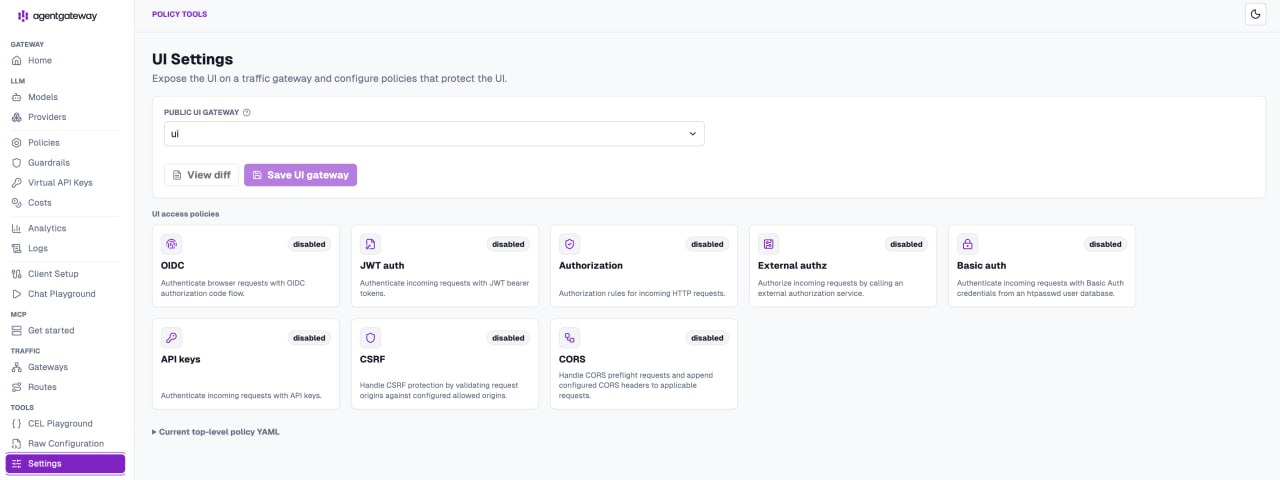
You get:
- Public UI gateway picker + view diff / save
- Policy cards: OIDC, JWT, Authorization, External authz, Basic auth, API keys, CSRF, CORS
- Expandable top-level policy YAML for the GitOps-minded
After upgrade: bind the UI to the gateway you actually expose, turn on OIDC or JWT, then put that listener on a real network.
6. Experimental AgentgatewayModel (off by default)
Kubernetes headline — with the official caveats.
AgentgatewayModel brings the standalone model-centric LLM experience to Kubernetes: serve multiple models on one gateway, route by model name in the request. Higher level than assembling AgentgatewayBackend + HTTPRoute body matchers by hand.
- Short names:
agmodel/agentgatewaymodels.agentgateway.dev - Experimental
- Off by default
- Existing APIs remain available
Why try it: one GitOps object per model/family, less HTTPRoute glue, k8s and standalone stop telling different stories.
Why not force it day one: experimental. Pilot one non-prod model after the cluster is stable on 1.4.
7. Guardrails, ext_proc, CEL, fault injection
Guardrails
BackendConnectionPolicyfor guardrail callouts (TCP/TLS/HTTP/tunnel) on OpenAI moderation, Bedrock guardrails, Google Model Armor- Default callout timeouts
- Clearer guardrail decisions in logs/UI
- ext_proc
failureMode(fail-open / fail-closed)
External processing
Controller support for metadataContext, requestAttributes, responseAttributes, plus failureMode.
CEL
- Custom CEL functions you can register for policies
- Opt-in CEL filters for OTel spans
- CEL filters that decouple OTLP log fields from stdout
source.connectHeadersfor inbound CONNECT headers- Header transformation replace mode via CEL
- Body handling split:
bodyvstruncatedBody(see security section)
CEL refs: k8s · standalone
Fault injection: delay
New delay traffic policy injects latency before forward. Duration string, CEL duration, or number-as-milliseconds. Injected delay counts against the request timeout.
Docs: k8s fault injection · standalone
8. LLM, A2A, and provider path fixes
From the official “LLM gateway enhancements” plus the long PR train:
- Frontend TLS multi-CA client cert validation
- Bedrock: Responses→Bedrock images, 64-char tool name sanitizing, cache-write tokens in access logs
- Gemini / Vertex: embeddings fix, native generateContent paths, detect-mode model/usage extraction
- Azure AI Foundry: Anthropic endpoints; Responses/date-based API path fixes
- A2A v1.0 agent card format in URL rewriting
- Reasoning fixes on messages→completions; body decode before JSON parse
- Cost: Prometheus counter; catalog ConfigMap loading; virtual keys from ConfigMaps
- Telemetry: tool calls, A2A response metrics, richer dtrace
- Semantic routing examples (including Responses)
Providers: k8s · standalone
9. Deployment and ops
- DaemonSet data plane (still defaults to Deployment)
- Helm
extraContainerson control plane pods - Proxy scrape via PodMonitor; standalone metrics Service + ServiceMonitor
agentgateway_controller_build_infometric- Standalone SQL logging for success and error, with faster writes
- Internal bind mode (annotation + wildcard fallback)
- Frontend policies targetable to a Gateway port
- Buffer: stream when body exceeds limit instead of always hard-failing
- ext_authz HTTP cache + custom HTTP bodies
agctlmuch smaller; some trace/config commands under proxy subcommand; nightly artifacts- s390x support
- Embedded UI build by default (
UI=0to opt out)
How I would upgrade
Kubernetes
- Re-apply Gateway API CRDs for the v1.6 / TCPRoute v1 set this release expects
- Bump
agentgateway-crds→ v1.4.0 - Bump controller + proxy together
- If you run authenticated MCP: read GHSA-mvgg-jvj2-4frq and validate session/route authz behavior
- Smoke HTTPRoutes, MCP, JWT/ext_authz, traces, guardrails
- Audit CEL auth that uses
request.body/response.body - Only then pilot one non-prod
AgentgatewayModel - Keep Deployment unless you truly need DaemonSet
Standalone
- Snapshot config
- Note:
bindsstill work; migrate with UI one-click or convert togatewaysdeliberately - Flatten any nested
auth.locationexpressions - Pick storage: sqlite local vs postgres HA (drop PVC assumptions from early charts)
- Open UI Settings, bind console, enable OIDC/JWT
- Install/upgrade
agentgateway-standalonev1.4.0 after reading values
Auth-heavy estates
- Inventory upstreams still on shared service accounts
- Prototype token exchange on one API
- Prototype Cross App Access for one MCP or SaaS API
- Prefer native Entra MCP provider over home-grown resource-parameter proxies
- Prefer hashed virtual keys / ConfigMap sources where you can
What I would turn on first
- Security fix path — upgrade MCP authz estates for the High advisory
- Gateway API CRD re-apply + clean 1.4 roll
- One gateway + UI Settings — console actually protected
- Token exchange or XAA — user-scoped upstream tokens
- MCP 2026-07-28 +
_metatraces — federation you can debug - Experimental AgentgatewayModel — one non-prod pilot, not a big-bang rewrite
Links
- Official v1.4.0 release
- Security advisory GHSA-mvgg-jvj2-4frq
- v1.3.1…v1.4.0
- Docs: Kubernetes quick start · Standalone quick start
- On this site: Eight principles of an AI gateway · Why the v1 line matters
Bottom line: 1.4 is not only features. It is MCP protocol catch-up, real delegated auth (token exchange + Cross App Access for MCP), standalone that can run UI/LLM/MCP on one port with DB-backed config, an experimental model API on Kubernetes, and a set of breaking + security fixes you should not skip.
Re-apply Gateway API CRDs. Bump charts. Read the MCP session advisory. Bind and lock down the UI. Then play with AgentgatewayModel — in that order.