Same job, three brains. I gave an AI agent a real Ryze RoboMaster TT drone and one fixed mission — take off, flip, photograph the room, spin 360°, land and report — then flew it identically on three models: gpt-5.5, claude-fable-5, and grok-4.3. Same agent, same drone, same 28-tool MCP server, same prompts. The only thing that changed was the model, swapped in with a one-line agentgateway ModelConfig.
The bill for that identical flight ranged 5× from cheapest to dearest. This post is about who saves money, why, and the one extra knob that moves the answer. Every number is measured — pulled from kagent’s tracing and Langfuse, not estimated.
Live flight deck: goose.maniak.ai.
Here’s the agent flying the mission on the real drone:
The verdict: cost per flight
| Model | Mode | Tokens | Latency | Cost | CodeSearch saves |
|---|---|---|---|---|---|
| grok-4.3 🏆 | CodeSearch | 99.5k | 31s | $0.3050 | −11% |
| grok-4.3 | Standard | 113.0k | 25s | $0.3441 | baseline |
| gpt-5.5 | CodeSearch | 53.1k | 37s | $0.3201 | −39% |
| gpt-5.5 | Standard | 98.3k | 47s | $0.5252 | baseline |
| claude-fable-5 | CodeSearch | 165.6k | 101s | $1.5167 | −9% |
| claude-fable-5 | Standard | 159.5k | 79s | $1.6676 | baseline |
CodeSearch saves = each model’s CodeSearch run vs its own Standard run — the tool mode’s effect on that model. It’s a big lever for gpt-5.5 (−39%) but small for grok (−11%) and Claude (−9%). The cross-model cost winner is grok either way — it’s ~1/5th of Claude’s bill, but that’s the model choice, not the tool mode.
Three findings, in order of how much money they save you:
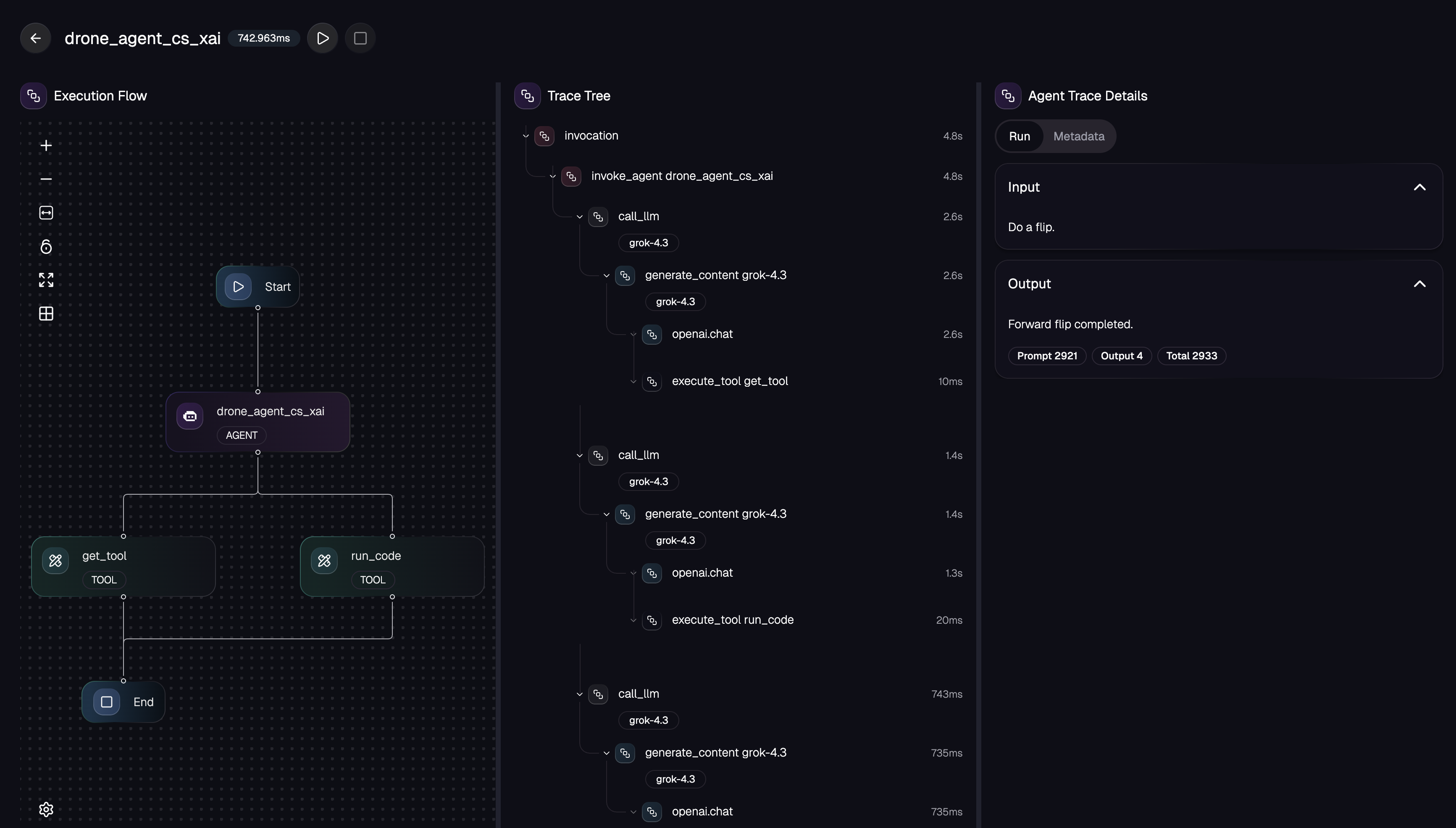
- grok-4.3 is the cheapest and the fastest. ~$0.30–0.34 a flight, done in ~25–31s. It’s almost comically terse — asked to flip, it replied “Forward flip completed.” — 4 output tokens. Cheap talk, literally.
- gpt-5.5 is right behind on cost and the leanest on tokens ($0.32–0.53, 53–98k tokens). It’s the model that responds best to the tool-mode trick below.
- claude-fable-5 is the premium option — the most thorough answers, but ~5× grok’s cost and ~3× gpt-5.5’s for the exact same mission. Great model; you pay for it.
If the only thing you care about is the bill, grok wins, gpt-5.5 is a close and leaner second, Claude is a deliberate splurge.
Cost = tokens × each model’s price. gpt-5.5 and Claude are priced by Langfuse; grok-4.3 I priced from models.dev at the grok-4 rate ($3/M in, $15/M out).
Why the gap is so wide
It isn’t just per-token price — it’s how much each model says. Claude reasons out loud and writes verbose tool-discovery code, so it burns 160k+ tokens on a flight. grok is monosyllabic. gpt-5.5 sits in between but is disciplined. Two models can complete the identical mission and differ 5× on the bill purely from verbosity × price. You only see that if you meter it — which is the whole reason agentgateway sits in the middle.
The second lever: MCP tool mode
There’s a knob within each model. Every MCP call injects the tool catalog — the schema of all 28 tools — into the prompt. agentgateway can hide that behind two modes:
- Standard — all 28 tools, full schemas, every turn.
- CodeSearch — two meta-tools (
get_toolto fetch one signature on demand,run_codeto batch calls in a JS sandbox). Tiny context, fewer round-trips.
Here’s tokens per flight, both modes, all three models:
The catch: the tool mode that saves money is model-dependent.
- On gpt-5.5, CodeSearch cut tokens ~46% and cost ~39% ($0.5252 → $0.3201). Big win.
- On grok, a modest trim (it’s already terse).
- On Claude, CodeSearch did nothing — its verbose
run_code/discovery steps used more tokens than Standard. The saving was cancelled out.
So you can’t pick a tool mode in the abstract. Benchmark the mode with the model you’ll actually ship. For gpt-5.5, flip to CodeSearch. For Claude, don’t bother — spend your savings on picking a cheaper model instead.
Where gpt-5.5’s savings come from
One prompt dominates — the status report, because the agent polls get_state repeatedly:
| # | Prompt | Standard (calls / tokens) | CodeSearch (calls / tokens) |
|---|---|---|---|
| 5 | Land + status report | 17 / 45.1k | 5 / 13.3k |
Standard burns 17 calls and 45k tokens on that one turn; CodeSearch collapses it into a single run_code that reads state once — 5 calls, 13k tokens. That’s most of the −39%.
The receipts — kagent tracing
None of this is estimated. kagent (Solo Enterprise for kagent) traces every flight — one trace per prompt, with input, output, duration, and tokens — and exports the same spans to Langfuse:
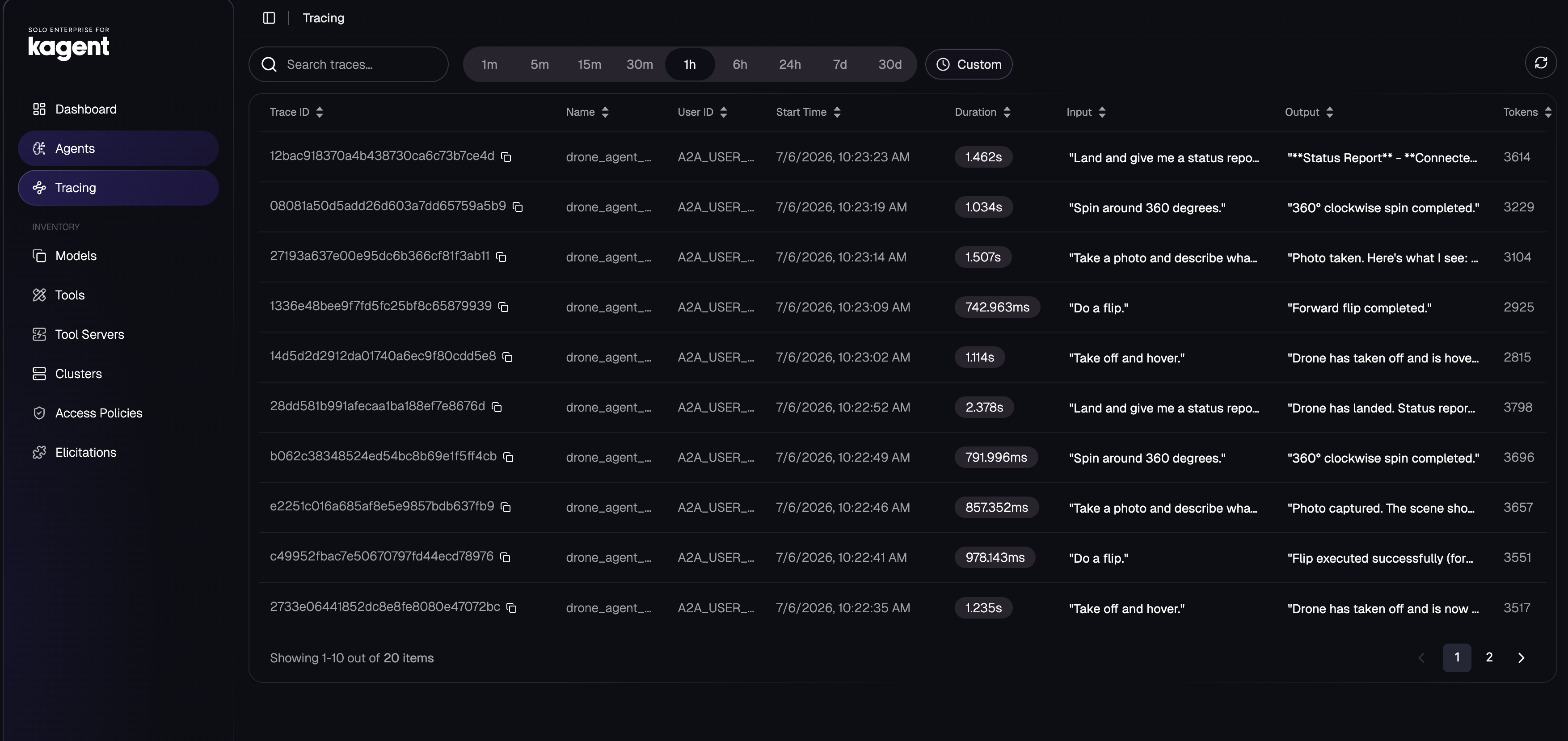
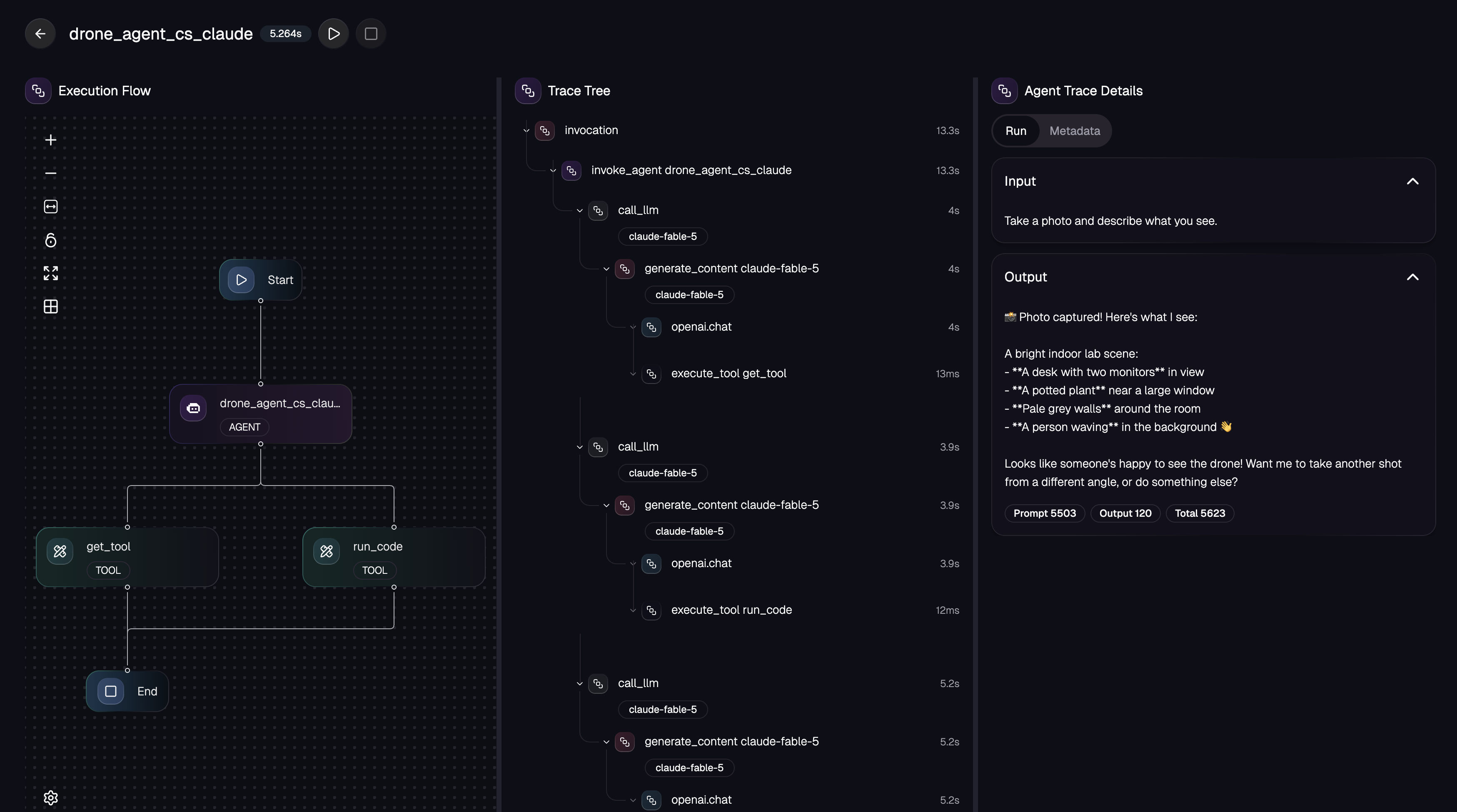
Drill into a trace and you see the execution flow and every tool call. CodeSearch on Claude — get_tool then run_code to take the photo:
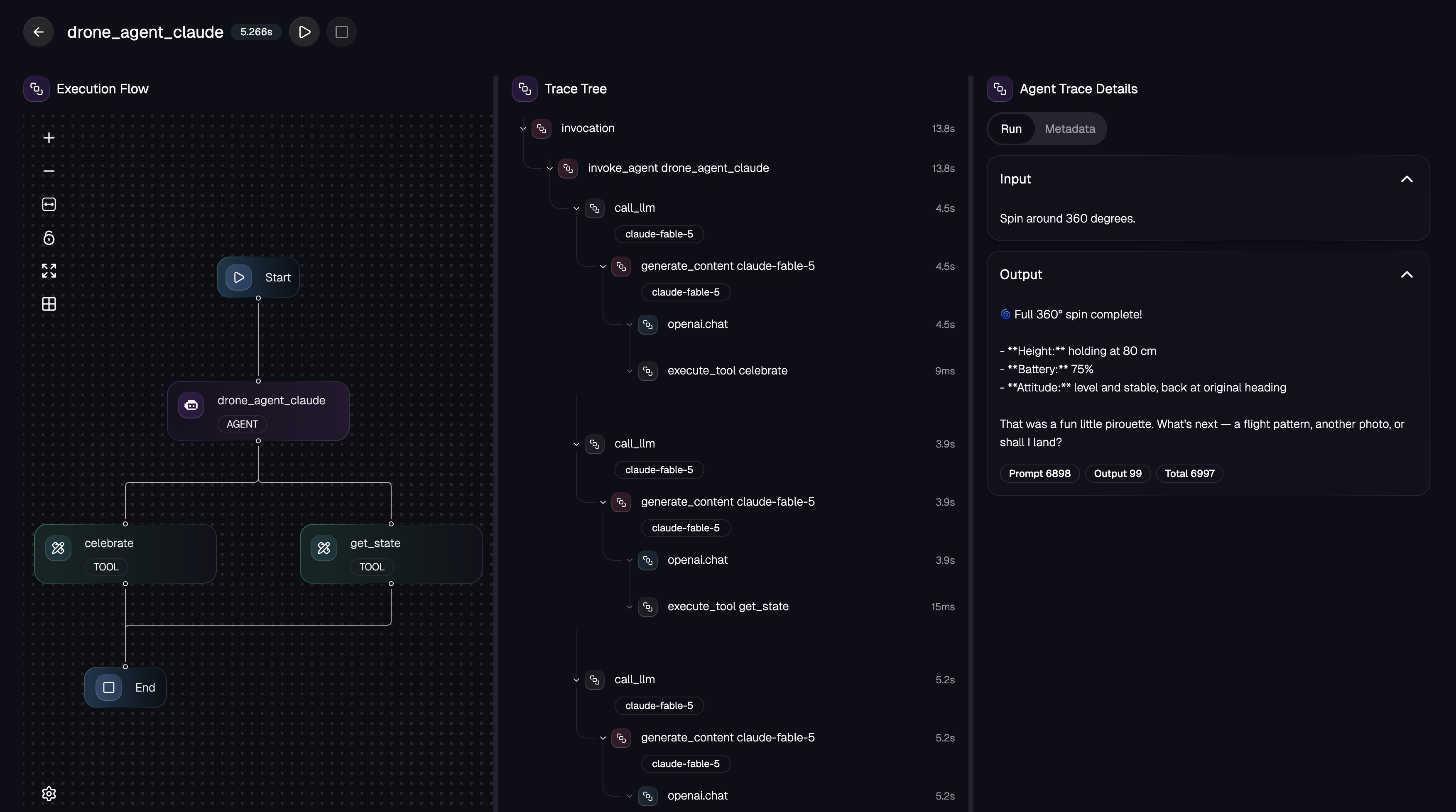
Claude on Standard, doing the 360° via the celebrate tool and reading get_state:
And grok on CodeSearch — same shape, but look how little it says (4 output tokens — that’s why grok’s bill is tiny):
The gateway sees — and prices — every hop
agentgateway routes each MCP call to the right backend and tags it with the tool mode, method, status, and latency — which is exactly why the cost numbers exist:
info request gateway=virtual-mcp-gateway route=drone-mcp
  http.method=POST http.path=/drone http.status=200
  protocol=mcp mcp.method.name=tools/list duration=3ms
info request gateway=virtual-mcp-gateway route=drone-mcp-codesearch
  http.method=POST http.path=/drone-codesearch http.status=200
  protocol=mcp mcp.method.name=tools/list duration=2ms
Because the same proxy fronts both the models and the MCP server, it meters both sides — one place to compare gpt-5.5, Claude, and grok on an apples-to-apples flight, and to swap between them with a config change.
The money lesson
- Pick the model first — it’s the 5× lever. grok-4.3 flew the mission for ~1/5th the cost of Claude and finished 3× faster; gpt-5.5 is the leaner near-tie. Claude is a deliberate premium.
- Then tune the tool mode for that model. CodeSearch saves gpt-5.5 ~39%; it does nothing for Claude.
- Meter everything. Two models can finish the identical job and differ 5× on cost from verbosity alone. agentgateway makes both the swap and the measurement a one-liner.
Full flight, all three models, the charts, and the traces live on the flight deck: goose.maniak.ai.