Every time an LLM talks to an MCP server, it has to be told what tools exist. That tool catalog — the JSON schema of every tool, its parameters, and descriptions — is injected into the prompt on every single turn. For a small server that’s a rounding error. For GitHub’s MCP server, with 28 read-only tools and verbose schemas, it’s 4,781 tokens of pure overhead per call — before the model has done any actual work.
That overhead is the hidden tax of MCP, and it’s the subject of this post. Using Enterprise agentgateway in front of GitHub’s official remote MCP server, I measured three different ways to expose those tools to an LLM and tracked the real USD cost of each. The result is clear and a little counter-intuitive: for a large catalog like GitHub’s, Search mode cuts per-call cost by ~60% and wins across conversations too.
All the code, manifests, harness scripts, and raw results are in the demo repo:
👉 sebbycorp/agentgateway-demos / 104-ent-github-tokenomics
This article walks through how it was deployed, what the numbers were, why they came out this way, and how you can flip your own gateway into Search mode.
The setup at a glance
| Component | Value |
|---|---|
| Backend | GitHub’s external remote MCP server — api.githubcopilot.com/mcp/readonly |
| Tools exposed | 28 read-only tools (get_*, list_*, search_*) |
| Front door | Enterprise agentgateway (injects the GitHub PAT as a Bearer token upstream) |
| Model | gpt-5.5 via the agentgateway /openai route |
| Scope | One dedicated public sandbox repo: sebbycorp/agw-tokenomics-sandbox |
| Pricing (est.) | input $0.005/1K · cached input $0.0025/1K · output $0.015/1K |
| Method | 5 questions × 3 modes (single-call) + a 5-turn conversation × 3 modes, run three times |
A key safety property: every question is pinned to a single repo, the gateway only talks to the /mcp/readonly endpoint (no mutation tools), and the GitHub PAT is fine-grained and scoped to that one repo. The test physically cannot touch anything else.
Architecture
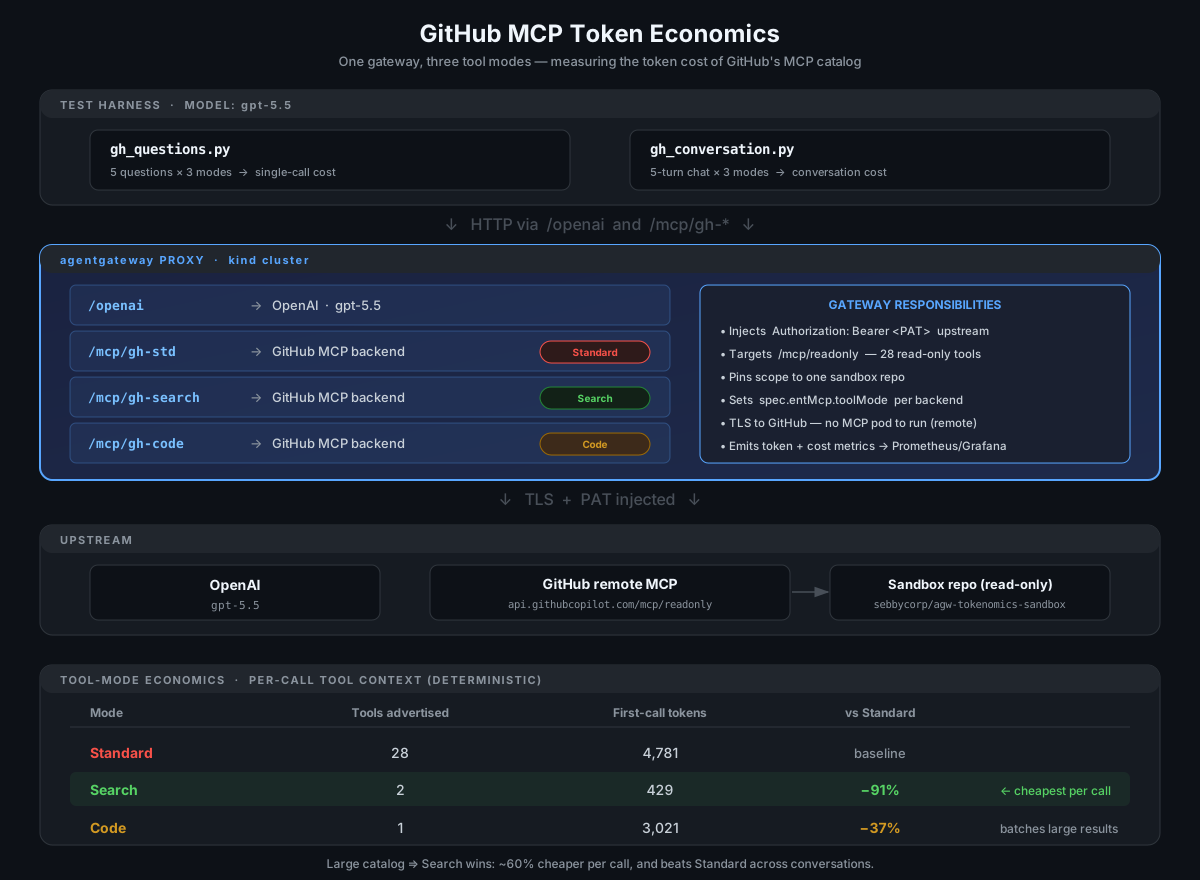
agentgateway sits between the LLM and GitHub. There is no MCP pod to build or run — GitHub’s MCP server is external and remote. The gateway targets it over TLS and injects your PAT. The same gateway also fronts the OpenAI-compatible model route, so one proxy sees both sides of the conversation and can meter tokens.
The three tool modes
The whole experiment hinges on how the gateway presents GitHub’s 28 tools to the model. Enterprise agentgateway’s MCP backend supports three toolMode values, each a different point on the “context vs. round-trips” trade-off.
Standard — the catalog goes in every turn
- What the model sees: all 28 tools, full schemas.
- Per-call context: ~4,781 tokens.
- Workflow: model picks a tool and calls it directly — no discovery step.
- Cost: you pay to re-send the entire catalog on every turn.
Search — progressive disclosure (the winner here)
- What the model sees: just 2 meta-tools,
get_toolandinvoke_tool. - Per-call context: ~429 tokens — a 91% reduction.
- Workflow: the model first discovers the relevant tool’s schema, then invokes it. That’s an extra round-trip, but each round-trip is tiny.
- Cost: dramatically less context per turn; you only pull in the schema you actually need.
Code — one tool, batch in JavaScript
- What the model sees: a single
run_codetool (with a 10-second sandbox timeout). - Per-call context: ~3,021 tokens — a 37% reduction.
- Workflow: the model writes JavaScript that calls multiple GitHub tools in one submission; only the final result returns to the transcript, keeping conversation history compact.
- Cost: higher first-call overhead than Search, but it shines when individual results are large and can be batched/summarized server-side.
These three numbers are deterministic — they’re a property of the tool catalog and the mode, identical on every run:
| Mode | Tools advertised | First-call tool tokens | vs Standard |
|---|---|---|---|
| Standard | 28 | 4,781 | — |
| Search | 2 | 429 | −91% |
| Code | 1 | 3,021 | −37% |
How it was deployed
The whole stack comes up with one script on a local kind cluster.
Prerequisites: kind, kubectl, helm, python3 (≥3.10), and three secrets:
cp .env.example .env
# Fill in:
#   AGENTGATEWAY_LICENSE_KEY   (Enterprise agentgateway)
#   OPENAI_API_KEY             (gpt-5.5 backend)
#   GITHUB_PAT                 (fine-grained, single-repo, READ-ONLY)

set -a; . .env; set +a
./deploy.sh
deploy.sh is idempotent and does the full bring-up:
- Creates a
kindKubernetes cluster - Installs the Gateway API CRDs
- Deploys the Enterprise agentgateway control plane
- Creates the
agentgateway-proxyGateway - Wires the OpenAI (
gpt-5.5) backend +/openairoute - Configures three GitHub MCP backends — one per tool mode — all pointed at the external MCP server with the PAT injected
The OpenAI side is a plain AgentgatewayBackend:
apiVersion: agentgateway.dev/v1alpha1
kind: AgentgatewayBackend
metadata:
  name: openai
  namespace: agentgateway-system
spec:
  ai:
    provider:
      openai:
        model: gpt-5.5
  policies:
    auth:
      secretRef:
        name: openai-secret
How to enable Search mode
This is the part most people want. The mode is a single field on the Enterprise MCP backend — spec.entMcp.toolMode. Here is the exact gh-search backend from the demo:
apiVersion: enterpriseagentgateway.solo.io/v1alpha1
kind: EnterpriseAgentgatewayBackend
metadata: { name: gh-search, namespace: agentgateway-system }
spec:
  entMcp:
    toolMode: Search          # <-- this is the whole trick
    targets:
      - name: github
        static:
          host: api.githubcopilot.com
          port: 443
          protocol: StreamableHTTP
          path: /mcp/readonly
          policies:
            tls: {}
            auth:
              secretRef: { name: github-pat }
              location:
                header: { name: Authorization, prefix: "Bearer " }
To get the other two modes, you change exactly one line: toolMode: Standard or toolMode: Code. The PAT lives in a Kubernetes Secret (github-pat) and the gateway adds Authorization: Bearer <PAT> on every upstream request, so the model never sees the credential. Each backend gets its own HTTPRoute (/mcp/gh-std, /mcp/gh-search, /mcp/gh-code) so the harness can hit all three side by side.
Note the path is /mcp/readonly, not /mcp/all/readonly — the former exposes only the 28 read tools; the latter would add mutation tools. For a cost benchmark (and for safety) we stay read-only.
The 5 questions
Every mode answered the same five questions against the sandbox repo:
- Describe the repo: description, default branch, primary language.
- List the 5 most recent commits with their messages.
- List the open issues with their titles.
- List the open pull requests with their titles.
- List the files in the
src/directory.
Results
Everything below is captured live on the GitHub — MCP Tool Modes Grafana dashboard the demo ships with. Here’s the at-a-glance view after a 5-turn conversation per mode:
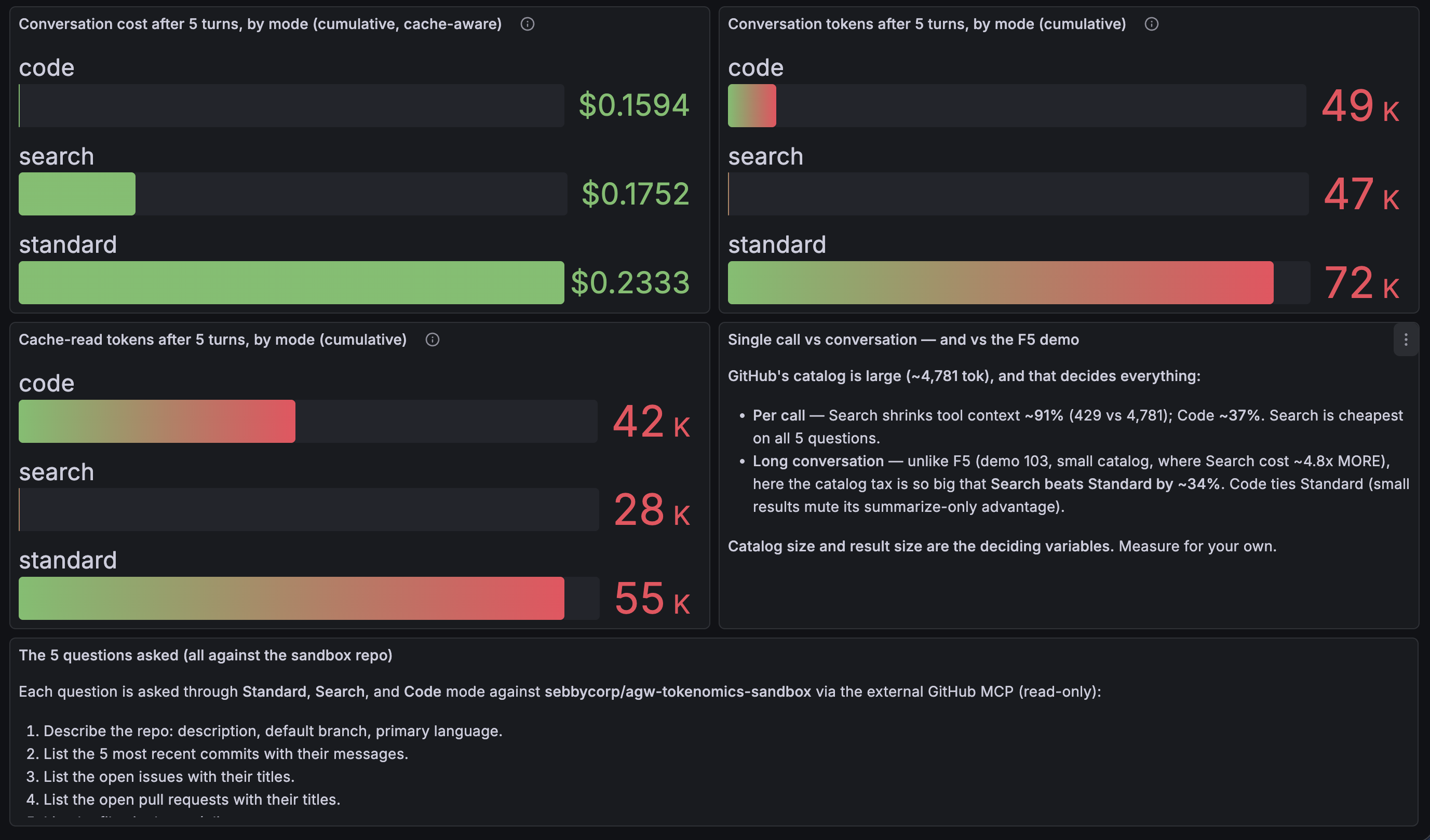
The numbers that follow break those panels down in detail.
Single call — one question, fresh session
| Question | Standard | Search | Code |
|---|---|---|---|
| repo | $0.03239 | $0.01347 | $0.02330 |
| commits | $0.03126 | $0.01726 | $0.02015 |
| issues | $0.02707 | $0.01451 | $0.01994 |
| prs | $0.03862 | $0.00743 | $0.01870 |
| contents | $0.03921 | $0.01246 | $0.01905 |
| average | $0.0337 | $0.0130 | $0.0202 |
Search is cheapest on all five questions — in every one of the three runs (~61% under Standard this run, 53–68% across runs). Code beats Standard but can’t overtake Search on a small repo: there’s too little per-task data for its batching to repay the higher first-call context.
Multi-turn conversation — cumulative cost per turn (latest run)
| Turn | Standard | Search | Code |
|---|---|---|---|
| 1 | $0.0322 | $0.0164 | $0.0221 |
| 2 | $0.0877 | $0.0438 | $0.0489 |
| 3 | $0.1316 | $0.0786 | $0.0911 |
| 4 | $0.1758 | $0.1167 | $0.1194 |
| 5 | $0.2333 | $0.1752 | $0.1594 |
Totals after 5 turns:
| Mode | Total tokens | Cache-read tokens | Cost | vs Standard |
|---|---|---|---|---|
| Standard | 71,768 | 54,912 | $0.233 | baseline |
| Search | 46,812 | 28,416 | $0.175 | −25% |
| Code | 49,020 | 41,856 | $0.159 | −32% |
Both Search and Code beat Standard. In this particular run Code edged out Search; in the prior two runs Search was cheapest. The constant across every run: Standard is the most expensive — re-sending GitHub’s catalog each turn is pricey, so avoiding it always pays.
Cache analysis (gpt-5.5 prompt caching)
| Mode | Cache-read tokens (5-turn convo) | % of total |
|---|---|---|
| Standard | 54,912 | 77% |
| Search | 28,416 | 61% |
| Code | 41,856 | 85% |
Does the Search win survive a different cache discount?
A fair question: gpt-5.5’s cached input is ~50% off. What if your cache is cheaper?
| Cache discount | cached $/1K | Standard | Search | Search ÷ Standard |
|---|---|---|---|---|
| 50% off (used here) | $0.00250 | $0.233 | $0.175 | 0.75× |
| 75% off | $0.00125 | $0.165 | $0.140 | 0.85× |
| 90% off | $0.00050 | $0.123 | $0.118 | 0.96× |
| 100% (cache free) | $0.00000 | $0.096 | $0.104 | 1.08× |
At realistic cache rates Search clearly wins. The margin narrows as cache gets cheaper, and only at the theoretical free-cache extreme does Standard’s huge-but-cached catalog edge ahead. Net: Search wins at normal cache rates; it’s a toss-up only in the free-cache limit. Code, with the largest cached share, is the most cache-rate-robust of the three.
Reproducibility — three runs
Single-call average per task:
| Run | Standard | Search | Code |
|---|---|---|---|
| 1 | $0.0410 | $0.0150 | $0.0335 |
| 2 | $0.0295 | $0.0140 | $0.0200 |
| 3 | $0.0337 | $0.0130 | $0.0202 |
Conversation cost after 5 turns:
| Run | Standard | Search | Code |
|---|---|---|---|
| 1 | $0.250 | $0.165 | $0.256 |
| 2 | $0.379 | $0.171 | $0.238 |
| 3 | $0.233 | $0.175 | $0.159 |
- Deterministic: first-call context (4,781 / 429 / 3,021) and tools advertised (28 / 2 / 1).
- Stable: Search is cheapest on all 5 single questions, every run; Search & Code both beat Standard in conversation, every run; Search is the most predictable (~$0.17).
- Noisy: Standard’s conversation cost ($0.23–$0.38) and the exact Search-vs-Code ordering.
The headline conclusion is robust to this noise.
Why the results came out this way
There are two costs in any MCP conversation, and they pull in opposite directions:
- Catalog tax — the tool schemas re-sent every turn. Standard pays this in full (4,781 tokens), every single call. Search nearly eliminates it (429 tokens). Code reduces it (3,021 tokens).
- Round-trip / transcript cost — Search’s discover-then-invoke pattern adds an extra model call, and a growing conversation re-sends history each turn.
For GitHub, the catalog tax dominates. The catalog is so large and verbose that paying it on every turn (Standard) swamps the small cost of Search’s extra discovery round-trips. So Search wins on single calls and holds up across conversations.
This is exactly why it’s worth measuring rather than assuming. In a previous demo (103, the F5 MCP server) the catalog was only ~1,588 tokens — small enough that the re-sent transcript, not the catalog, dominated. There, Standard actually won in conversation and Search was up to ~4.8× worse. Same three modes, opposite verdict:
| F5 (103), ~1,588-tok catalog | GitHub (104), ~4,781-tok catalog | |
|---|---|---|
| Search, single call | ~−18% vs Standard | ~−60% vs Standard |
| Search, 5-turn convo | +380% (≈4.8× worse) | −25% to −55% (better) |
Catalog size is the deciding variable. The bigger and chattier your MCP server’s tool definitions, the more Search mode saves you.
Why enabling Search matters
If you’re routing a real coding agent or chatops bot at GitHub’s MCP server, Standard mode means you’re paying a ~4,800-token surcharge on every turn of every conversation, forever. Flipping toolMode: Search:
- Cuts single-call cost ~60% and conversation cost 25–55% in these tests.
- Is the most predictable option — a tight ~$0.17 per 5-turn chat across all runs, while Standard swings 60%.
- Scales with catalog growth — as GitHub (or any vendor) adds more tools, the catalog tax grows and Search’s advantage widens.
- Costs you one line of YAML and a tiny bit of extra latency from the discovery round-trip.
Reach for Code mode instead when individual tool results are large (big file contents, long issue threads): batching multiple calls and returning only summaries server-side keeps the transcript small and can pull ahead of Search.
Reproduce it yourself
git clone https://github.com/sebbycorp/agentgateway-demos.git
cd agentgateway-demos/104-ent-github-tokenomics

cp .env.example .env   # AGENTGATEWAY_LICENSE_KEY, OPENAI_API_KEY, GITHUB_PAT (read-only, single-repo)
set -a; . .env; set +a
./deploy.sh

kubectl port-forward deployment/agentgateway-proxy -n agentgateway-system 8080:80 &
kubectl port-forward svc/prometheus-prometheus-pushgateway -n observability 9091:9091 &

LLM_NO_TEMPERATURE=1 ./harness/.venv/bin/python harness/gh_questions.py     # 5 Qs × 3 modes
LLM_NO_TEMPERATURE=1 ./harness/.venv/bin/python harness/gh_conversation.py  # 5-turn chat × 3 modes
Point at a different repo with GH_REPO=owner/name, or go interactive:
./harness/.venv/bin/python harness/gh_chat.py search "list the open issues"
A Grafana dashboard (GitHub — MCP Tool Modes) visualizes the token and cost metrics:
kubectl port-forward svc/grafana -n observability 3001:80
Clean up with ./cleanup.sh.
Takeaways
- For a verbose catalog like GitHub’s, the per-call context reduction is huge — Search −91%, Code −37% — and it translates directly into dollars.
- Avoid Standard for a big catalog. It’s the most expensive and least predictable mode.
- Search is the safe pick. Code can edge ahead when results are large; their order flips run-to-run on small data.
- Caching helps every mode (~61–88% from cache) but doesn’t change the ranking.
- Catalog size and result size decide the winner. The F5 demo had the opposite verdict. Measure for your catalog.
The full repo, manifests, and harness: 👉 github.com/sebbycorp/agentgateway-demos/tree/main/104-ent-github-tokenomics
Related reading: